Combining Custom Orthotics with Core and Hip External Rotator Training
Many people with flat feet (pes planus) and knock knees (genu valgum) believe that the problem exists only in the feet. However, in reality, the alignment issue often involves the entire lower-body kinetic chain — from the feet to the pelvis and core.
For this reason, treatment focused only on insoles may not be enough. A more effective approach is often a combination of:
- Custom-made orthotics (insoles)
- Core stabilization training
- Hip external rotator strengthening
- Movement re-education
This integrated strategy can improve posture, walking mechanics, pain, and long-term joint stability.
Understanding the Alignment Pattern
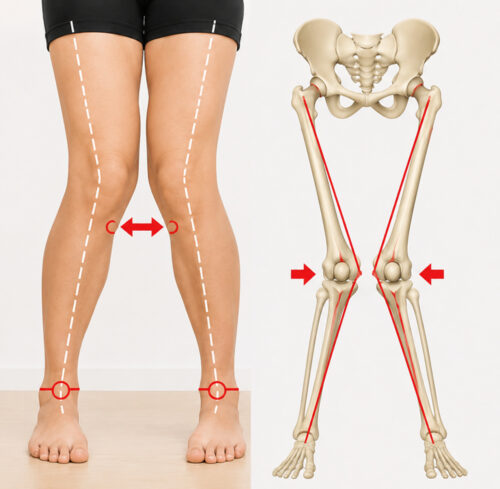
In many patients with flat feet and knock knees:
- The knees collapse inward
- The feet rotate outward
- The arches flatten
- The pelvis loses stability
This pattern is sometimes called a “valgus collapse” pattern.
When the hip muscles and core fail to stabilize the body properly, the lower leg compensates by rotating. As a result:
- the knees drift medially (inward),
- while the toes often point outward.
This creates excessive stress throughout the lower limb.
Why the Big Toe Often Becomes Painful or rigid.
An important but frequently overlooked consequence of this alignment pattern is stress on the first toe (hallux).
Because the knees move inward while the feet rotate outward, abnormal pressure develops around the first metatarsophalangeal joint (big toe joint). Over time, this may contribute to:
- hallux valgus (bunions)
- stiffness of the big toe
- first toe pain
- overload of the medial forefoot
- inefficient push-off during walking
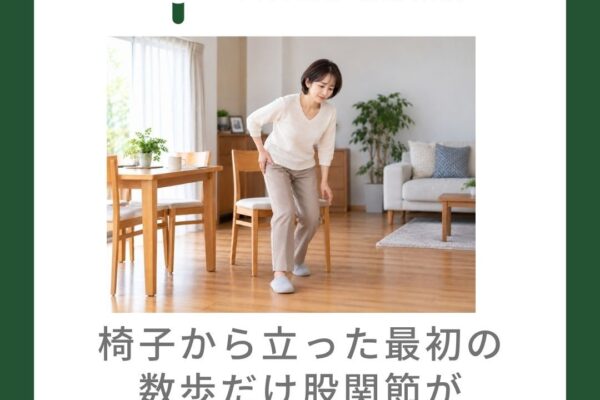
In many cases, patients complain of:
- pain around the base of the big toe,
- fatigue during walking,
- or difficulty maintaining balance during single-leg standing.
The foot is often trying to compensate for poor proximal stability from the hip and trunk.
The Role of Custom Orthotics
Custom orthotics help by:
- supporting the medial arch,
- reducing excessive pronation,
- improving weight distribution,
- and stabilizing foot mechanics during gait.
However, orthotics alone do not fully retrain movement patterns.
If the hip and core muscles remain weak, the knees may continue collapsing inward despite wearing insoles.
This is why exercise therapy is essential.
Why Hip External Rotators Matter
The hip external rotators — especially the gluteus medius and deep rotator muscles — help control femoral alignment.
When these muscles are weak:
- the femur internally rotates,
- the knees collapse inward,
- and foot pronation increases.
Strengthening these muscles can improve:
- lower limb alignment,
- walking efficiency,
- pelvic stability,
- and knee control.
Common exercises include:
- clamshells
- side-lying hip external rotation
- monster walks
- single-leg stability training
- bridge variations
Core Stabilization Is Equally Important
The core acts as the foundation for lower-extremity control.
Without trunk stability, the pelvis becomes unstable, leading to compensatory movements in the hips, knees, and feet.
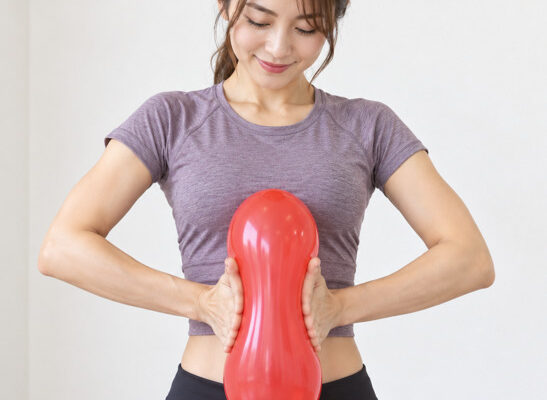
Deep core training may include activation of:
- transversus abdominis
- multifidus
- diaphragm
- pelvic floor muscles
These muscles work together to create postural stability and efficient movement patterns.
A Combined Approach Works Best
In clinical practice, we often see the best results when orthotic therapy is combined with targeted exercise rehabilitation.
The goals are not only to:
- support the foot,
- but also to retrain the entire movement system.
This comprehensive approach may help:
- reduce pain,
- improve walking mechanics,
- enhance posture,
- prevent progression of deformity,
- and improve long-term function.
Final Thoughts
Flat feet and knock knees are rarely isolated foot problems. They often reflect a broader issue involving posture, hip control, and core stability.
Custom orthotics can provide an important structural foundation, but combining them with hip and core training may produce more lasting and functional improvements.
By addressing both alignment and movement control, patients can often achieve better comfort, better balance, and healthier walking mechanics.
e-mail : info@physiocenter.jp
2nd floor , E-building The Jikei University Hospital
3-19-18 Nishi- Shinbashi, Minato- ku, Tokyo 105-0003
TEL +81-3-6402-7755
Kosaku Ota : Physical therapist ( English available )