Some people begin to experience new or persistent symptoms many years after undergoing scoliosis correction and spinal fusion surgery—sometimes 10 or 15 years after the operation.
Common concerns may include:
- “I constantly have pain along the inner border of my shoulder blade.”
- “My upper back always feels tight, and even after massage, the tightness quickly returns.”
- “I have recently started experiencing low back pain.”
When these symptoms occur, it is understandable to want to relieve the pain and muscle tightness while avoiding unnecessary stress on the surgically fused spine.
Why, then, can these symptoms appear many years after surgery?
Differences in the Rib Cage and Scapular Position May Remain After Spinal Correction
This may be particularly relevant for people who had a significant thoracic scoliosis curve before surgery.
Although the spinal curvature itself may have been substantially corrected through surgery, asymmetry or structural changes in the ribs and rib cage that developed over many years may remain to some degree.
Thoracic scoliosis is not simply a sideways curvature of the spine. It also involves vertebral rotation, which can contribute to asymmetry in the ribs and overall shape of the thorax.
Therefore, even after the spine has been corrected and stabilized through fusion, some asymmetry may remain in the rib cage—the “foundation” on which the scapula rests and moves.
As a result, the position and movement of the scapula may remain asymmetrical or become less mechanically efficient.
Pain Along the Inner Border of the Scapula Is Not Always Simply a “Tight Muscle”
The scapula moves by gliding over the surface of the rib cage.
When there is residual asymmetry of the thorax, maintaining a stable scapular position may become more difficult. The muscles surrounding the scapula may therefore need to work continuously to maintain stability.
Depending on the relationship between the rib cage and scapula, certain muscles may also remain in a relatively lengthened position while being repeatedly loaded.
This may contribute to symptoms such as:
- Pain along the inner border of the scapula
- Persistent upper-back tension
- A strong sensation of muscle tightness
- Discomfort after remaining in the same position for a prolonged period
An important point is that a painful muscle is not necessarily a muscle that is simply “short and tight.”
In some cases, the muscle may actually be maintained in a lengthened position because of the alignment of the scapula and rib cage. Repeated loading in this position can contribute to pain, fatigue, and a persistent sensation of muscular tension.
Low Back Pain May Also Be Related to Upper-Body Alignment
Low back pain occurring after scoliosis correction and spinal fusion should not necessarily be viewed as an isolated problem of the lumbar spine.
When part of the spine has been surgically fused, the body must perform everyday activities—such as standing, walking, sitting, and lifting—using the mobility that remains available in other regions.
If the alignment of the upper body, including the rib cage and shoulder girdle, is not well balanced, other areas may need to compensate.
This can potentially increase mechanical demands on the lumbar spine and pelvis.
Repeated compressive, shear, or rotational stresses around the lumbar spine and pelvis may contribute to the development or persistence of low back pain.
Therefore, when the lower back hurts, the source of the problem may not necessarily be limited to the lower back itself.
Why Does the Pain Return After Massage or Stretching?
Massage and stretching may temporarily reduce muscle tension, improve circulation, and relieve pain around the scapula or lower back.
However, if the underlying relationship between the rib cage, scapula, pelvis, and overall movement pattern remains unchanged, the same tissues may once again be overloaded during everyday activities.
This can lead to a familiar pattern:
“The treatment makes me feel better, but after a few days, the pain comes back.”
For this reason, it is important not only to focus on the painful area itself, but also to consider why excessive mechanical stress is repeatedly concentrating in that area.
Improving Scapular and Thoracic Alignment
Rehabilitation after scoliosis correction and spinal fusion requires careful consideration of the surgically altered spine.
The goal should not be to force movement through fused spinal segments or to apply excessive corrective forces.
Instead, rehabilitation may include:
- Assessing the relationship between the rib cage and scapula
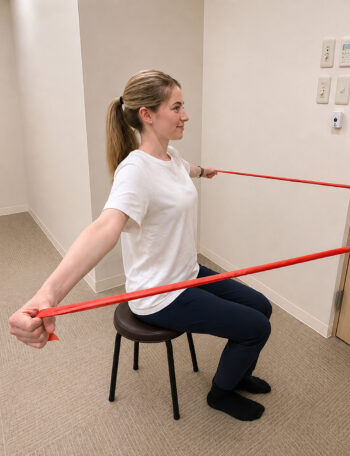
- Improving the function of muscles that stabilize the scapula
- Identifying muscles that are being excessively loaded
- Using breathing to facilitate appropriate movement of the rib cage
- Improving the relationship between the upper body and pelvis
- Strengthening the muscles needed to maintain improved alignment
Rather than simply “stretching what feels tight” or “massaging where it hurts,” the aim is to help the body relearn how to maintain a more efficient and less stressful position during everyday activities.
Improving Upper-Body Alignment May Help Reduce Stress on the Lower Back
Improving scapular and thoracic alignment is not only intended to relieve shoulder and upper-back symptoms.
When the position of the upper-body center of mass and left-right balance improve, unnecessary mechanical stress on the lumbar spine and pelvis may also be reduced.
For this reason, rehabilitation for low back pain after scoliosis correction and spinal fusion should not necessarily focus exclusively on the lumbar region.
Instead, it can be important to assess the entire body—including the rib cage, scapulae, lumbar spine, and pelvis—and understand how these regions interact during posture and movement.
Rehabilitation Should Respect the Surgically Fused Spine
People who have undergone scoliosis correction and spinal fusion surgery should not necessarily be treated in the same way as someone with general low back pain or ordinary shoulder stiffness.
The extent of spinal fusion, the original scoliosis curve, residual thoracic asymmetry, scapular position, and the condition of the lumbar spine and pelvis vary considerably from person to person.
Most importantly, rehabilitation should not attempt to force movement through the fused segments of the spine.
Instead, treatment should be adapted to the individual, with attention to thoracic and scapular alignment, pelvic position, muscle activity, breathing, and movement patterns.
Even when scapular pain or low back pain develops many years after scoliosis surgery, it should not simply be dismissed as something that “cannot be helped because of the surgery.”
A careful assessment can help identify where mechanical stress is being concentrated and why, allowing exercise therapy to be tailored to the individual’s current condition.
If you have been experiencing persistent pain along the inner border of the shoulder blade, upper-back or right-shoulder tension, or low back pain many years after scoliosis surgery, please feel free to contact Physio Center for an assessment.
Physio Center
2nd Floor, Building E
The Jikei University Hospital, Tokyo
Email: info@physiocenter.jp
TEL: 03-6402-7755
Physio Center
Physical Therapist: Ota
International Schroth Scoliosis Therapist