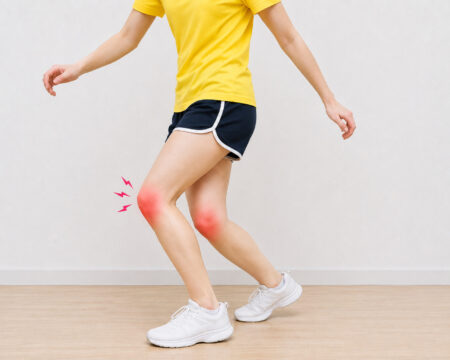
During periods of growth, children and teenagers may experience pain around the kneecap during sports or everyday activities.
Pain may occur when going up or down stairs, running, jumping, or squatting. Some children may also experience pain at the front of the knee after exercise.
In some cases, the kneecap (patella) may have a tendency to move outward, which can contribute to pain or a feeling of instability.
When treating these types of knee problems, it is important to look beyond the painful knee itself and assess the movement and balance of the entire lower limb, from the hips all the way down to the feet.
Hip Function Can Affect Knee Pain
When we walk, run, or go up and down stairs, the hips, knees, ankles, and feet do not work independently. They work together as a coordinated system to support and control the body.
For example, if the hip and gluteal muscles are not providing sufficient strength or control during activities such as standing on one leg or squatting, the knee may tend to move inward.
When this movement pattern is repeated, additional stress may be placed around the kneecap, potentially contributing to pain.
For this reason, exercise therapy does not focus only on the knee and thigh muscles. We also work on strengthening the muscles around the hips and buttocks and improving lower-limb control so that the knee can move more efficiently and remain stable during activity.
The Foot Arch Can Also Affect the Knee
Another important area to assess is the foot.
In some children, the arch of the foot drops significantly when standing or walking, causing the foot to roll inward.
When the foot rolls inward excessively, the lower leg and knee may also tend to rotate or move inward, which can affect the way the knee functions during weight-bearing activities.
Therefore, when assessing knee pain, we look not only at the shape of the foot but also at how the foot moves during standing, walking, and activities such as a single-leg squat.
Insoles May Be Used to Support the Feet
If the foot arch collapses significantly and this appears to be affecting knee movement or contributing to pain, insoles (foot orthoses) may be used to provide additional support.
The purpose of an insole is not simply to “raise the arch.”
Appropriate foot support can help improve the way the feet and knees move during standing, walking, and running, providing a more stable foundation for the entire lower limb.
However, insoles should not be relied upon alone. They are most effective when combined with strengthening exercises for the hips and knees and training to improve movement and body control.
Why a Whole-Body Approach Is Especially Important During Growth
During childhood and adolescence, significant changes in height and body weight can occur over a relatively short period of time. Sometimes muscle strength and movement control may not develop at the same pace as bone growth.
This can be particularly important for children and teenagers who participate in sports, where movements such as running, jumping, landing, and rapidly changing direction place repeated demands on the knees.
For this reason, we assess a number of factors, including:
- Hip and gluteal muscle strength
- Thigh and knee muscle strength
- Foot arch function and ankle mobility
- Standing, walking, and running patterns
- Movement control during squatting, jumping, and landing
Based on these findings, an individual exercise program can be developed according to each child's specific needs.
Knee pain does not necessarily mean that the problem is located only at the knee.
By considering the hips, knees, and feet as one connected system and improving overall lower-limb function, we can help reduce stress on the knees.
This approach can help growing children and teenagers return more comfortably and confidently to sports and everyday activities.
How Physio Center Can Help
If your child is experiencing knee pain, kneecap instability, or problems related to the foot arch, please feel free to contact us for an assessment.
At Physio Center, our physical therapists specializing in foot and lower-limb rehabilitation carefully assess each child's individual physical characteristics and movement patterns, examining the entire lower limb from the hips and knees to the feet.
Based on the assessment, we provide comprehensive rehabilitation and conditioning centered on exercise therapy. When appropriate, we may also use insoles, braces, or other forms of support to help reduce pain and improve movement and overall lower-limb function.
Physio Center
The Jikei University Hospital, Building E, 2nd Floor, Tokyo
Email: info@physiocenter.jp
TEL: 03-6402-7755
Physio Center
Physical Therapist: Ota (English-speaking)